Antimatter Dimensions Challenges Guide: Best Order and Strategy
This Antimatter Dimensions challenges guide explains how challenges work, which order is safest, how to recover when an autobuyer conflicts with a restriction, and when Infinity Challenges are worth the attempt.
Short answer: For a safe Antimatter Dimensions challenge order, clear low-friction Normal Challenges after your first Infinities, delay restriction-heavy runs until autobuyers and Infinity upgrades make recovery faster, and treat Infinity Challenges as the next layer rather than an early shortcut.
This Antimatter Dimensions challenges guide is meant for players who already know the early loop from Dimensions to Big Crunch but are unsure which challenge to run next. Exact formulas belong on the community wiki; this page focuses on practical routing, common failure points, and how each challenge type fits into the larger Infinity, Eternity, and Reality progression.
Quick Navigation
Antimatter Dimensions Challenge Order: Quick Route
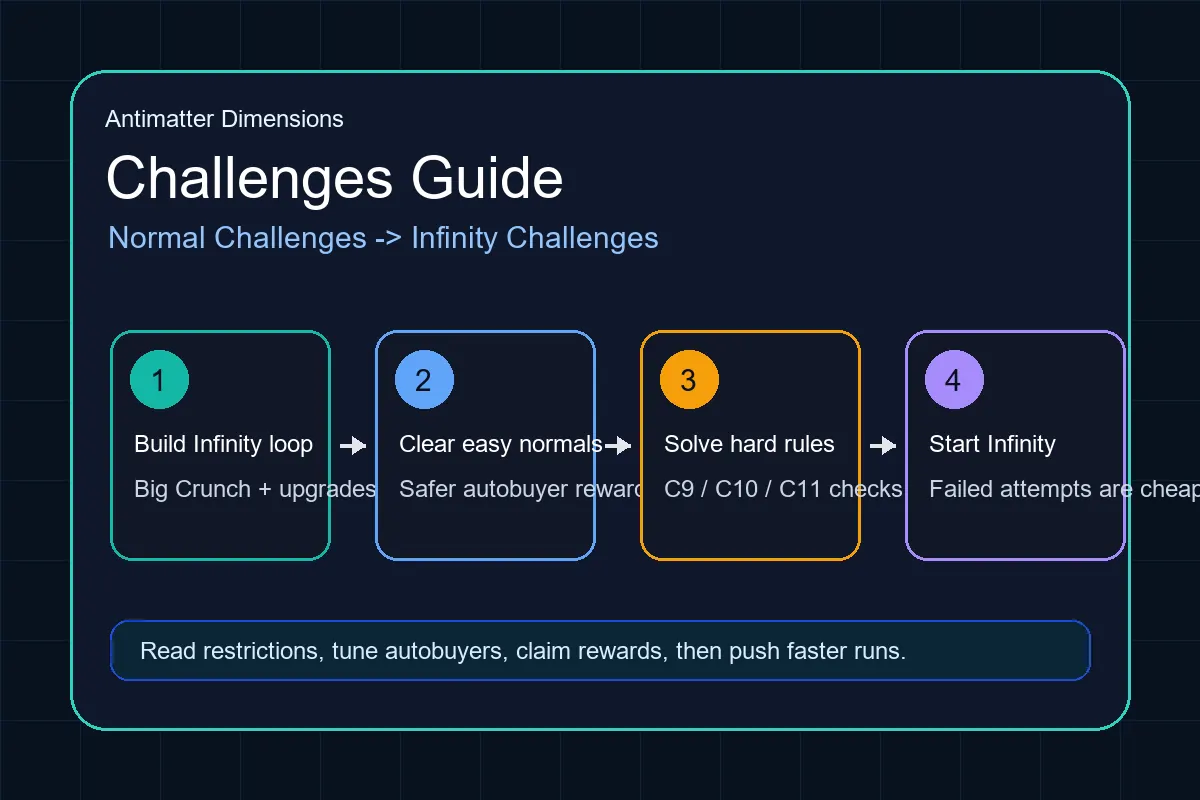
Challenges work best when a normal run can rebuild quickly after a reset. Take easy rewards first, watch which mechanic each restriction removes, and use this challenge order as a practical route instead of forcing every challenge as soon as it appears.
- Reach your first Big Crunch and buy early Infinity upgrades so repeat runs are shorter.
- Complete the Normal Challenges that only slightly change the early production loop.
- Delay the challenges that interfere with Dimension buying, Tickspeed rhythm, or automated recovery until your autobuyers are stronger.
- After each reward, run a normal Infinity to confirm that the reward actually shortened your route.
- Tune autobuyer priorities before difficult attempts; a bad automatic setup can make an otherwise easy challenge look impossible.
- Start Infinity Challenges only when Big Crunches are repeatable enough that failed attempts are not wasting long manual sessions.
Normal Challenges vs Infinity Challenges
The word challenge covers two different phases. Normal Challenges teach early restrictions and reward automation improvements. Infinity Challenges arrive later and ask whether your Infinity setup can handle harsher rule changes.
| Challenge type | When to attempt it | Main goal |
|---|---|---|
| Normal Challenges | After you can Infinity more than once and have enough upgrades to rebuild without long manual clicking. | Unlock stronger autobuyers and make repeat Infinity runs smoother. |
| Hard Normal Challenges | After easier Normal Challenges and several useful Infinity upgrades are done. | Solve awkward restrictions such as slow growth, reduced buying freedom, or bad multiplier timing. |
| Infinity Challenges | When Big Crunches are routine and you can recover from failed attempts quickly. | Earn rewards that improve the post-Infinity route and prepare for later progression. |
If you are still before your first Infinity, use the beginner route first. Challenges become less frustrating once the basic loop of Dimensions, Tickspeed, Dimension Boosts, Sacrifice, Galaxies, and Big Crunch is familiar.
Antimatter Dimensions Challenge Order
A good Normal Challenge order minimizes time spent in awkward rulesets. You want early rewards, not long stalled attempts that could have been solved by one more Infinity upgrade.
Start with the restrictions you understand immediately
Run the challenges where the restriction is obvious and the solution is mostly normal play with a small adjustment. These teach you to watch recovery speed instead of only watching the largest antimatter number.
Use rewards to improve autobuyer behavior
Normal Challenge rewards are valuable because they make repeated runs less manual. After a reward unlocks or upgrades an autobuyer, check whether your normal route becomes faster before jumping into the next hard challenge.
Do slow challenges after your economy is stronger
Some Normal Challenges feel bad because they remove a convenience or slow a production layer. If progress crawls for several minutes, exit, complete easier rewards, buy more Infinity upgrades, then come back.
Keep save backups before experimentation
Challenge attempts are usually safe, but changing many automation settings at once can make your next runs confusing. Export a save before a long setup session, especially if you are also testing imports or edited saves.
How Challenges Work and How to Get Faster Times
There is no mandatory challenge order. Clear quick rewards first, simplify the conflicting autobuyer during a restricted run, shorten the Infinity loop, and return to slow challenges when the same attempt costs less manual recovery.
| Situation | Recommended action | Why it works |
|---|---|---|
| A challenge finishes with normal autobuyers | Clear it immediately | The reward improves later runs at almost no opportunity cost. |
| Production stalls after a reset | Disable conflicting autobuyers and rebuild manually once | You can see which purchase rule is fighting the challenge restriction. |
| The run is slow but still accelerating | Wait for the next multiplier or upgrade breakpoint | Restarting too early can waste a run that is close to compounding. |
| The run is flat for several minutes | Exit, improve Infinity upgrades, then retry | A stronger baseline is usually better than forcing a dead attempt. |
Challenge 11: prioritize multipliers, not normal buying rhythm
Challenge 11 punishes familiar purchase habits. Watch which Dimensions are actually producing, buy around the restriction, and use manual control until the run becomes stable. If progress stays flat, leave and return after more Infinity upgrades.
How to get faster Normal Challenge times
Fast times are a cleanup goal, not the first-clear goal. Return after your Big Crunch loop is short, autobuyers are configured, and each challenge can be completed without long manual recovery. Change only one setting at a time.
Hard Normal Challenges and How to Think About Them
Players often search for help because one challenge suddenly feels much slower than the others. The issue is rarely one missing click; it is usually a mismatch between the restriction and your current automation or upgrade level.
| Challenge | Why it feels hard | Practical fix |
|---|---|---|
| Challenge 9 style restrictions | The run can punish careless buying patterns and make normal bulk-buy habits less effective. | Slow down, buy deliberately, and return later if autobuyers are creating a messy rhythm. |
| Challenge 10 and late Normal Challenges | The run may expose weak Infinity upgrades or poor recovery after resets. | Complete easier rewards first, then retry once your normal Infinity loop is shorter. |
| Challenge 11 style restrictions | Players often underestimate how much one disabled mechanic changes the early production chain. | Focus on the remaining production source, use Tickspeed carefully, and do not compare the run to normal speed. |
| Any challenge that stalls after a reset | Autobuyer priorities can rebuild the wrong tier or spend resources too early. | Temporarily simplify automation, observe one manual recovery, then re-enable settings that clearly help. |
When to Start Infinity Challenges
Infinity Challenges are not just longer Normal Challenges. They belong to a later phase where you should already have repeatable Big Crunches, useful autobuyers, and enough Infinity upgrades to recover from failed routes.
Before your first Infinity Challenge
Make sure a normal Infinity run no longer feels like a full manual playthrough. If each Big Crunch still requires constant attention, improve upgrades and automation before attempting harsher restrictions.
During early Infinity Challenges
Treat each attempt as a diagnostic. If production slows, ask what the challenge removed: a multiplier, a Dimension path, a buying pattern, or a reset timing. Then change that part of your route instead of restarting randomly.
After a reward unlocks
Run a normal Big Crunch and compare recovery speed. A reward that looks small can become important because it makes future challenges and repeat Infinities more consistent.
Common Challenge Mistakes
Most failed challenge sessions come from forcing the wrong timing, not from missing a secret trick.
- Starting every challenge as soon as it appears instead of waiting for upgrades that shorten recovery.
- Leaving autobuyers on settings that worked in a normal run but conflict with a challenge restriction.
- Restarting a hard challenge repeatedly without first checking whether a different completed reward would help.
- Treating all Normal Challenges as equal; some are quick lessons, while others are better after more Infinity progress.
- Using save edits to force progress instead of making a backup and testing the challenge route normally.
Useful Next Resources
Use these links depending on where your run is stuck:
- Read the dedicated Challenge 9 guide for the exact cost-collision rule, autobuyer setup, and manual purchase loop.
- Read the beginner guide if you have not reached repeatable Infinity yet.
- Review Dimensional Sacrifice if your pre-Infinity recovery feels slow.
- Back up your save before changing many autobuyer settings or testing imports.
- Plan Eternity Challenges once you are past the Infinity layer.
- Use the Infinity Challenges guide for the next challenge layer.
- Check the community guide for version-specific details and exact challenge mechanics.
FAQ
Bottom line: challenge progress is smoother when you treat each run as a test of one missing mechanic. Clear easy Normal Challenges, upgrade your Infinity loop, solve the awkward restrictions with better automation, then move into Infinity Challenges once failed attempts are cheap.